Showing posts with label Water. Show all posts

Wednesday, 21 April 2010

Over and Out, for now..

Having never actually brought this blog to a close, it was brought to my attention last week whilst interviewing for this year's volunteers that I should really give a finishing summary of how things ended up.  So here I am, back in Scotland in April 2010, again tasked with the challenges of consultancy engineering and now four months on from the end of the PRODECI placement.

In the past months I have given interviews to magazines and written some reports for my various sponsors about my time in Ecuador, so now for any online readers still out there, I now aim to provide a concise debrief from a very enjoyable and successful six months!


Community Footbridge, Pamplona, Intag
Article from Bridge Design and Engineering (March 2010) click here

In 1997, the El NiƱo weather phenomenon caused massive floods throughout Ecuador. In Pamplona, Intag, an important footbridge was washed away: separating the community in two halves. The community quickly rebuilt a structure in its place from felled tree logs and local timber, which after twelve years had deteriorated and become unstable.


After some years of requests for funding, the community secured funds for a new footbridge from the Inter American Development Bank. The community sought help from the NGO PRODECI, who provided the president with a design of a standard footbridge that had been produced by Ecuadorian engineers some years earlier. Without the engineering capabilities, PRODECI could offer only very limited help.


In the summer months (April-October) the Rio Pamplona has shallow parts where it is possible to cross by wading. The majority of the children who attend the community school live on the other side of the river, and crossed each day in this manner. In winter (November-March) the river becomes a torrent, and children were too frightened to cross, so school attendance was dramatically down.


"We cross by going through the water. The bridge has a lot of broken parts on the deck, and we are scared to cross. In winter, we have to use the bridge. Some of us help each other by holding hands"

Child of Pamplona's Primary School


A secondary motive to replace the bridge was to improve links for agriculture, which is essential to the community in Pamplona. In the winter months cattle cannot cross the river, and produce can’t easily be brought over the river.


Mountainous Landscape and Tropical Climate of Pamplona, Intag

Mules are commonly used for transportation in the steep terrain,
in this case to bring deck timbers down from the mountainside


Over the course of three months, I took on the project management of the footbridge, first reviewing and modifying the standard bridge design to suit the site conditions, then producing construction drawings, and buying the remaining materials and tools needed. I contracted a skilled labourer to oversee the construction of footings and concrete columns, and to teach the local community basic construction methods. This proved beneficial in later stages where the men of the community constructed all of the remaining bridge works: gabion baskets, concreting and earthworks to stabilize river embankments, then installation of the cable and deck.


The successful completion of the bridge has given the community a secure crossing over the Rio Pamplona. The provision of this bridge should result in improved education levels with higher primary school attendance and a betterment of the local economy, especially due to the ability of farmers to cross with produce.


"The solidarity shown by EWB-UK has made the people from Pamplona gain incentive and promote themselves. As well as the technical aspects, the volunteers have considered the human aspects. The people are sharing the communal work, they are taking their children to see what is being built, and they are seeing that the whole scene is changing completely. More than anything the children are happy to have a safe place to cross, after being abandoned for so many years"

Ruth Almeida, Coordinator of Intag Area for PRODECI


Community members "test-load" their new suspension footbridge

Thursday, 20 August 2009

Progress by the Barrel Load..?

The economy of Ecuador is heavily reliant on petroleum, along with agriculture and tourism. The petroleum reserves are located in the vast Amazonian rainforest extents east of the central Sierra, known as the Orient. This is the region of the country where you will find sparsely populated indigenous groups, speaking traditional native languages, and living off the land as they have done for centuries.

These communities are having some real problems maintaining their livelihoods in the face of the bulldozers and oil drilling machines working their way through the rainforest. It is becoming clear that Ecuador is finding it difficult to strike a balance between accelerating its economic growth and maintaining progress in social and human development.

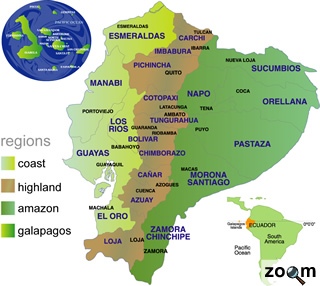
Physical Map of Ecuador. Three distinct regions run North to South: The Coast, The Sierra, The Amazon/Orient.

Spillages of crude oil are common in the Orient. In recent years there have been some twenty incidents each year, mostly attributed to technical faults and human negligence on the part of PetroEcuador. June this year saw one of the worst incidents of recent times where a leak of heavy metal liquid contaminated the underground aquifer. What was, until recently, a rich supply of geologically filtered water to the communities, could now require decades to return to a safe level of toxicity.


Newscutting from El Comercio, Quito and Ecuador national paper.

Rafael Correa , the first indigenous president of Ecuador, was recently voted in for a second four-year term. Despite the right wing propaganda in private mainstream media, he remains popular with both the city middle classes, and the remote poorer communities, who await his promises of social reforms.

It seems justified that his government is making the most of their natural resources in order to fuel economic development. This is essential to fulfill the social reforms that were promised. The problem as I see it, as is often the case in developing nations with natural resources, is the lack of supervision and control over the activities of self interested private firms such as PetroEcuador.


PetroEcuador Flag over La Mariscal, Quito

A large part of my work here involves the design and installation of small scale community water systems in Intag. Not only does potable water provision form a crucial part of the development of rural communities, it is also a basic human right, and a fundamental part of the UN Millennium Development Goals.

It is disappointing and frustrating that despite the work we are undertaking to further the quality of life of communities in Intag, in a neighbouring province just over 100 km away things are going in completely the other direction.

There seems little justification that this sustainable lifestyle, formed by the Amazonians over centuries, is the sacrifice that is being paid for the barrels of oil that may allow the government to fulfill its electoral promises.

Sunday, 2 August 2009

Bienvenido a Intag

On the recently constructed road into Santa Rosa. Sunhat and sunblock are mandatory
for the fierce Equatorial Sunshine.

Before heading up North to begin the development projects, 24th July was marked by city-wide celebrations for national patron Simon Bolivar, liberator of Ecuador from Spanish rule. The celebrations coincided with my second last night in the city, and my third last night as a 23 year old. This gave me good reason to join the Ecuadorians and begin celebrations in an open top bus through the old city, followed by a weekend of traditional and modern parties.

Ibarra is a far smaller city than Quito, it has a warmer climate due to its lesser altitude, and affords its inhabitants the priviledge of abundant clean air, which was too often lacking in the congested capital. On arrival I was taken to my apartment by the past president of PRODECI who shared a coffee with me and welcomed me to the city.

The office of PRODECI is a base for all fifteen of the foundation´s various engineers, agronomists, and educational and healthcare professionals. I spent the day on Monday getting to know them during some meetings, lunch, and then after work where they kindly presented me with a birthday cake. My first impressions are of a well equipped team with dedicated and competent professionals working on a variety of projects to improve the quality of life of communities in various provinces in Northern Ecuador.

I spent the remainder of the week working in Intag, which is a remote and sparsely populated mountainous region about a three hour drive from Ibarra. We have an apartment in Nangulvi where I stayed for four days, every day traversing the mountain slopes in 4x4 vehicles which are necessary to cover the rocky roads between villages.

The majority of my work this week has involved travelling between the various villages and having meetings to get to know the communities and talk with them about their water supplies. I have been fortunate to work with Ian Baggs, my EWB project manager, who worked here last year for six months on water projects. He is a great source of knowledge on the multitude of problems and solutions in water supply systems.

Meetings in the office last week were also very informative. It looks like PRODECI have a number of additional engineering projects that will need my input, including design of a hydroelectric renewable energy scheme, the design and construction of a replacement bridge at a strategic river crossing, and a number of school buildings and water supply systems as were previously planned.

I´m looking forward to working with PRODECI on these projects. Meeting the beneficiaries, assessing the social impacts, and then designing and constructing these schemes allows me to have a far more direct and immediate impact than would have been possible from an office in the UK.


View from the open top bus on route through Quito´s Old Town. Simon Bolivar Day.

At Cuicocha lake below Volcano Cotacachi, reputed highest active Volcano on Earth. Near Intag.
With Ruth Almeida, Ex-Presidenta of PRODECI.


Ian and I chat with Don Aurelio at a spring capture point. Don Aurelio is president of Quinde whose community are having problems with a poorly constructed water supply scheme built some years back by an Ecuadorian engineer.
Development gone wrong. We aim to fix that.


On the left you can see a buried water pipeline. A few months ago a landslide caused the ground surrounding it to slide away and here you can see the crater that remains.
The water supply scheme is in good working operation.


Sunday, 5 July 2009

How it all began...

For the rest of 2009 I will be living and working in Ibarra in Northern Ecuador to undertake engineering development with PRODECI, an Ecuadorian Non-Government Organisation.  I was chosen by the charity Engineers Without Borders UK to undertake this placement, and I have been given leave from my work at Tony Gee and Partners until early 2010.  More information on the organisations involved can be found here:
http://www.ewb-uk.org

I will be working on the following engineering projects during the six months:
1. The design and construction of ten school buildings to serve rural mountainous communities.
2. The design and installation of twenty small scale water supply schemes.

Over the past weeks and months I have been preparing for this placement through technical and non-technical training courses, Spanish language courses, and lots of reading on the wider issues of humanitarian development.  

I have been lucky to met some really inspirational people during the past few weeks: some of them wise and experienced development workers who have seen it all through decades in Africa... and some other young and willing engineers, like me, ready to start out on their development placements in the far corners of the world.

I leave for Ecuador on Friday 10th July, so I have a few final days here in the UK to finalise the paperwork and see some friends and family.  

I'm really excited about arriving in Ecuador later this week, and looking forward to meeting the people I will be working with over the next six months. I will try to keep this blog up to date with photographs and stories about my adjustment to life in the sub-tropical Andes, and more importantly how the projects are improving schools, education, water, sanitation, and the quality of life of communities in the area.